
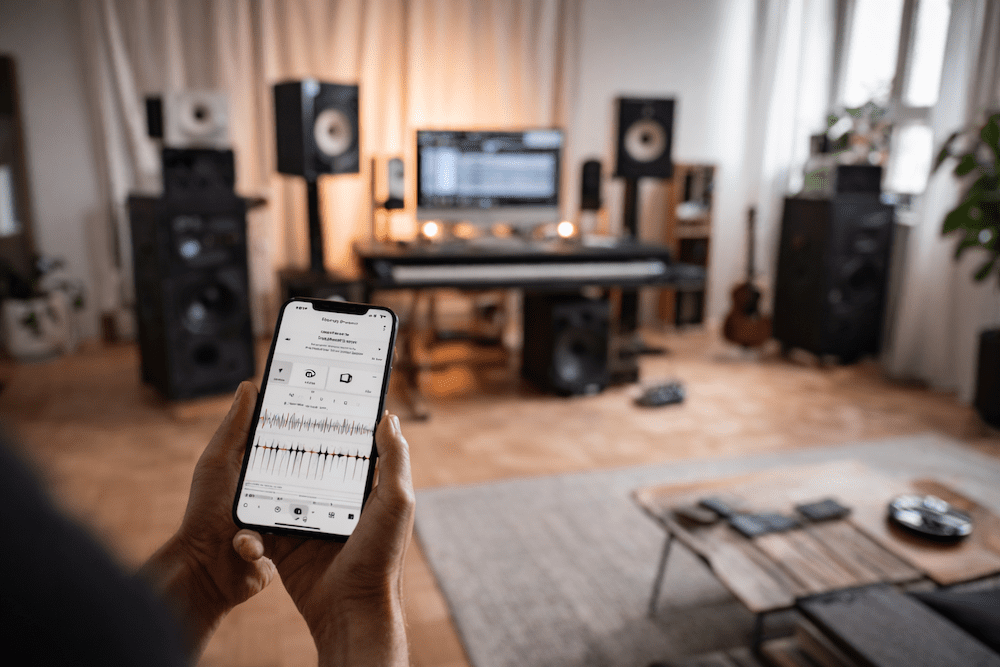
DIY soundproofing often starts with good intentions and a weekend trip to the hardware store. But without measuring your room first, you’re guessing. Panels get hung. Corners get stuffed. Echo barely changes. Real improvement begins with data.
Before you build a single upcycled panel or staple one reclaimed blanket to a wall, take ten minutes to understand what your room is actually doing. Taking proper acoustic measurements before you start changes everything. Ten minutes with the right app tells you whether your room suffers from excessive reverberation, bass buildup in the corners, or noise leaking through a specific wall. You stop guessing.
Whether you’re creating a podcast corner, a music room, or improving the acoustics around an audiovisual equipment installation, simple measurements will show you where your DIY soundproofing efforts should go.
When you measure first, you stop decorating and start solving.
Why DIY Soundproofing Should Always Start With Measurement
DIY soundproofing isn’t one problem. It’s usually three:
- Too much echo (reverberation)
- Bass buildup in corners
- Noise leaking through weak structural points
Without identifying which one you’re dealing with, you risk treating the wrong surfaces. Measurement tells you whether your space needs absorption, isolation, or bass control. That clarity saves time, money, and materials — especially when you’re working with upcycled components that vary in density and performance.
Good upcycling is intentional. Measurement makes it precise.
Understanding Reverberation Before DIY Soundproofing
Reverberation time (RT60) measures how long sound lingers after the source stops. Clap your hands in a tiled bathroom and you’ll hear a long ringing tail. That’s high reverberation. In a carpeted bedroom filled with furniture, sound dies quickly. That’s low reverberation.
For most home rooms, an RT60 between 0.3 and 0.6 seconds feels balanced. Higher than that, speech becomes muddy. Lower than that, the room can feel unnaturally dead.
If your DIY soundproofing goal is cleaner audio, lowering RT60 with absorption panels is often the first move. But measure first. Don’t assume.
Identifying Noise Leaks in DIY Soundproofing Projects
Sound transmission is different from echo. It’s about sound passing through walls, doors, ceilings, and gaps.
Common weak points:
- Hollow-core interior doors
- Single-pane windows
- Gaps under doors
- Electrical outlets on shared walls
- Thin drywall partitions
DIY soundproofing panels won’t fix transmission issues if the real problem is air gaps. Sealing cracks or adding mass to a door may outperform covering an entire wall in absorption.
Measurement reveals where sound is actually escaping.
Measuring Frequency Response for Better DIY Soundproofing
Low frequencies cause the biggest headaches in small rooms. Bass waves are long and reflect between parallel walls, creating standing waves. Some notes boom. Others disappear.
Corners are the primary pressure zones. That’s why bass traps belong there, not randomly across flat walls.
A frequency response graph shows peaks and dips. Large peaks indicate resonance that needs thick, dense absorption. Thin decorative panels won’t touch those frequencies.
DIY soundproofing becomes dramatically more effective when you target bass properly instead of spreading lightweight material everywhere.
Tools That Make DIY Soundproofing More Accurate
You don’t need professional studio gear to get meaningful results.
Free Software
Room EQ Wizard (REW) is free and widely used for home acoustic measurement. It generates test tones and produces detailed graphs showing reverberation time and frequency response.
Smartphone Apps
Apps like Decibel X or NIOSH SLM provide basic sound pressure level readings. They’re not perfectly calibrated, but they offer a helpful starting point.
Budget Measurement Microphones
A simple USB measurement mic such as the Behringer ECM8000 or Dayton Audio UMM-6 costs under fifty dollars. Paired with REW, it dramatically improves accuracy.
If you’re investing hours into DIY soundproofing builds using reclaimed wood, salvaged insulation, or recycled denim, a fifty-dollar mic is smart insurance.
How to Interpret Your DIY Soundproofing Data
Start with RT60. If your readings are above 0.8 seconds in a small room, you likely need more absorption.
Next, review the frequency response graph. Look for:
- Large low-frequency peaks (bass buildup)
- Sharp narrow spikes (room resonances)
- Deep dips (standing wave cancellations)
Absorption reduces peaks. Dips are harder to fix and often require repositioning speakers or seating.
Always prioritize the largest acoustic issues first. Don’t obsess over minor irregularities when a massive bass peak is dominating the room.
Planning Upcycled Materials for DIY Soundproofing
Now your data becomes a blueprint.
Low-frequency problems require thickness and density. Upcycled denim insulation packed tightly into reclaimed wood frames makes effective DIY bass traps. Old mineral wool offcuts work too.
Mid and high frequencies respond well to lighter materials:
- Vintage wool blankets
- Repurposed heavy curtains
- Reclaimed fabric over absorption cores
- Salvaged mattress foam (for mid/high, not bass)
Reflection points — identified during measurement — are ideal placement zones.
If your room becomes too dead, reclaimed wood slat diffusers can scatter sound instead of absorbing it. Every salvaged material has an acoustic personality. Measurement tells you where it belongs.
Measuring Again After Your DIY Soundproofing Build
This is where it gets satisfying.
Run the same tests again. Compare graphs. Watch RT60 drop. See bass peaks flatten. Notice smoother frequency response.
If certain issues remain, you now know exactly where to improve. Each project builds skill. Each measurement compounds knowledge.
Your third DIY soundproofing build will outperform your first because you’re working from evidence, not guesswork.
When DIY Soundproofing Isn’t Enough
Sometimes measurements reveal structural problems. Severe low-frequency transmission through shared walls. Structural resonance from HVAC systems. Complex flutter echo in irregular spaces.
These issues go beyond surface panels.
New York Soundproofing specializes in interpreting acoustic data and engineering structural solutions when DIY soundproofing reaches its limits. When the problem is bigger than a weekend project, expert intervention protects both your time and your design.
